Volkswagen is the embodiment of German engineering: precision, restraint, the steady rhythm of factory life. So, you might be surprised to learn that VW makes a famous currywurst. Not sponsors one or just serves it in a cafeteria. VW manufactures its own branded sausage and ketchup, complete with official part numbers, because of course it does!
And yes, it’s wildly popular with the masses.
Volkswagen currywurst has become one of those quietly iconic German cultural exports: beloved, a little funny, and strangely emblematic of the country’s relationship with industry. It’s a sausage with a corporate identity, and arguably the most famous in-house food product made by any car company in the world.
So what exactly is VW currywurst? And why do people care so much about a sausage made by the company that gave the world the Beetle, the Golf, and, of course, the iconic VW Bus.
WTF is Volkswagen currywurst?
Volkswagen currywurst is a pork sausage produced by Volkswagen’s own meat-processing unit (yes, that’s a real thing!), originally created to feed workers at VW’s massive Wolfsburg plant. The wurst is served with traditional curry ketchup and curry powder as it has been for generations.
The VW currywurst isn’t just a fun novelty item. It’s a serious product, made to consistent standards, and the sausage has been sold not only in factory cafeterias but also in supermarkets in Germany. Over the years, it’s become a cult favorite among workers, Volkswagen fans, and currywurst lovers in general.
When people ask, “What is Volkswagen currywurst?” what they’re really asking is: How did a car manufacturer end up producing one of the most famous sausages in Germany?
The answer is simple: branding and scale. “Volkswagen” means, “the people’s car,” and in Germany currywurst is the people’s food.
When you’re feeding tens of thousands of German factory workers a day, you don’t mess around with logistics or tradition. You control supply, quality, and cost, and you give the people what they want. The solution wasn’t to outsource massive meat orders or import pasta from Italy. Instead, they wisely decided to manufacture the traditional sausage in-house with German engineering, tradition, and pride.
Question: If Fahrvergnügen means, “driving enjoyment,” then what German word means “currywurst enjoyment”?
Why is VW currywurst so popular?
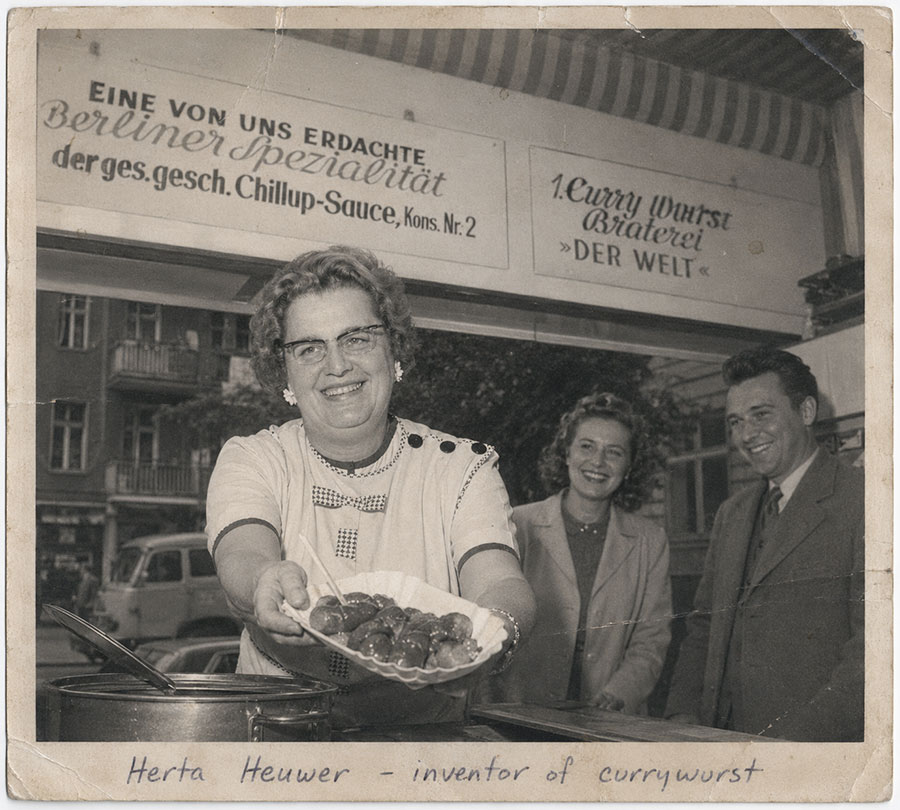
To understand the popularity of Volkswagen currywurst, it helps to understand currywurst itself. Currywurst is Germany’s greatest street food. Invented by Herta Heuwer in the ashes of WWII, it’s fast, warm, savory, slightly sweet, and a little spicy. It’s the kind of meal you eat standing up outside a kiosk, or in a canteen on a tight schedule, or during a rainy afternoon when you want something comforting and uncomplicated.
Volkswagen currywurst became popular for the same reasons Volkswagen cars once dominated: reliability, familiarity, and a certain working-class pride. For factory employees, it was more than a lunch. It was their lunch, and deeply connected to the identity of the plant and the daily life of the workforce.
Over time, word spread. People outside the Volkswagen factories wanted to try it. It became a fun “insider” product, a kind of delicious corporate trivia.
Volkswagen currywurst has a part number
One of the most charming details about VW currywurst is that it has an official Volkswagen part number, just like a car component. It’s the kind of story that sounds made up, until you realize Volkswagen probably does paperwork better than anyone on Earth.
The curry ketchup also has its own part number.
This is the essence of the VW currywurst mystique: a blue-collar food treated with corporate seriousness, made by an industrial giant, eaten by people building German-engineered machines that travel the world.
What is the Volkswagen currywurst part number? The bratwurst is part number 199 398 500 A, while the VW ketchup is part number 199 398 500 B
Is Volkswagen currywurst still made today?
Yes, Volkswagen currywurst is still produced and incredibly popular, particularly because it has become a symbol in larger conversations about tradition, modern corporate identity, and even plant-based food transitions.
At times, changes to cafeteria menus have sparked surprisingly emotional reactions, including from high-profile German public figures, because Germans, it turns out, can be intensely sentimental about their sausage.
And maybe that’s the whole point.
Where is VW currywurst sold? Sorry Americans, but you can only get Volkswagen currywurst in Europe. Specifically, it’s sold in VW cafeterias, dealerships, and select stores.
The reason VW currywurst matters
Volkswagen currywurst isn’t just a quirky fad. It’s a reminder that companies aren’t only brands; they’re communities, ecosystems, and habits. And sometimes the most enduring symbol of a global manufacturer isn’t the product on the showroom floor.
So, what’s next, Tesla Brisket?
Anyway, Volkswagen makes good cars, but I heard their sausage is the wurst!
Did you know that over 800 million Currywursts are eaten in Germany every year?
Currywurst is more than just a dish; it’s a cultural icon in Germany, embodying the country’s post-war history, its capacity for innovation, and its embrace of simple yet profoundly satisfying cuisine. The story of currywurst is a narrative of creativity, survival, and the birth of a culinary phenomenon, intertwined with the life of Herta Heuwer, a name synonymous with this beloved dish.
How was Currywurst invented?
Our spicy tale begins in the ruins of post-World War II Berlin, a city divided by war and politics, yet united in its quest for recovery and normalcy. Amidst this backdrop, in 1949, Herta Heuwer, a resourceful woman with a keen sense for business and cooking, played a pivotal role in culinary history. Herta ran a snack stand in the British sector of Berlin, where she began experimenting with ingredients available at the time.
The invention of currywurst came out of both necessity and ingenuity. Heuwer obtained ketchup(or possibly Worcestershire sauce, according to some accounts) and curry powder from British soldiers stationed in the city. She mixed these with other spices and poured the sauce over grilled pork sausage, creating a dish that was both novel and tantalizingly flavorful.
The unique combination of savory, sweet, and spicy elements in her sauce was an instant hit. Heuwer patented her “Chillup” sauce in 1951, solidifying her creation’s place in the annals of gastronomy.
Currywurst and German Culture
Currywurst quickly transcended its humble beginnings to become a staple of German fast food, beloved by people from all walks of life. Its appeal lies not only in its taste but also in its simplicity and accessibility. It’s commonly served sliced on a paper plate with a wooden fork, accompanied by a side of bread or fries, embodying the German principle of “Einfachheit” (simplicity) and “Gemütlichkeit” (comfort).
The dish’s popularity soared in the decades following its invention, becoming a symbol of the German economic miracle (“Wirtschaftswunder”) of the 1950s and 1960s. As Germany rebuilt itself, currywurst fed the workers, the dreamers, and the doers, becoming ingrained in the fabric of German society. It’s a testament to the country’s resilience and innovation, a simple pleasure that provided a sense of normalcy and comfort during times of upheaval.
Currywurst Today: Wurst Is the Best!
Today, currywurst is more than just German street food; it’s a cultural phenomenon, celebrated and debated with equal passion. It’s estimated that over 800 million servings are consumed in Germany each year, a testament to its enduring popularity. Cities across Germany, especially Berlin and Hamburg, claim superiority in their versions of the dish, each boasting unique interpretations of the sauce and preparation methods.
The dish’s significance is further highlighted by the existence of the Deutsches Currywurst Museum in Berlin, which operated from 2009 to 2018. This museum dedicated itself to exploring the history, preparation, and cultural impact of currywurst, featuring interactive exhibits and, of course, tastings. Although the museum has closed, its legacy, much like that of currywurst, endures in the hearts and minds of Germans and international fans alike.
A Song About Currywurst!?
Currywurst has also permeated German arts and media, underlining its status as a cultural icon. It’s been immortalized in song by Herbert Grönemeyer in his 1982 hit “Currywurst,” which humorously narrates a man’s love for the dish. This song and others like it underscore how deeply embedded currywurst is in the German cultural psyche, celebrated not just as a food item but as a piece of the nation’s soul.
Berlin even had a Currywurst Museum that attracted tens of thousands of tourists per year complete with Currywurst-inspired decor and furniture!
Herta Heuwer. Now there’s a name that deserves a place in the culinary hall of fame, and not just for inventing a snack, but for creating an edible piece of postwar German culture.
If you’ve ever enjoyed a plate of currywurst, you’ve got Herta to thank for it. And her story? Well, it’s got all the flavor and spice of the dish she made famous.
Let’s Set the Scene: Berlin, 1949
Germany in 1949 was a country picking itself up from the rubble of World War II. Berlin, in particular, was divided and devastated. Food was scarce. Good spirits were even scarcer. But amid the ruins, people were trying to rebuild not just homes and businesses—but a sense of normalcy.
Enter Herta Heuwer, a resourceful, saucy, determined woman who didn’t just see empty streets and hungry people, she saw opportunity.
Who Was Herta Heuwer?
Herta was born in 1913 in Königsberg, which was part of East Prussia at the time (now Kaliningrad, Russia). After the war, she moved to West Berlin, and like many women of that time, she was doing what she could to make a living in the chaos. In 1949, she managed to get her hands on a food cart and set up shop on the corner of Kantstraße and Kaiser-Friedrich-Straße in the Charlottenburg district of West Berlin.
But here’s the thing: the options for street food in postwar Berlin were bleak. Think plain sausages, boiled potatoes, and maybe a crust of bread. Not exactly something to write home about, and kind of depressing after you’ve lost WW II.
So Herta did what any good innovator would do—she got creative.
The Birth of Currywurst
Legend has it that on September 4, 1949, during a slow day at her food stand, Herta started experimenting in the kitchen. Thanks to her connections with British soldiers, who had access to rations from abroad, she was able to get her hands on some ketchup, Worcestershire sauce, and curry powder, which were practically unicorn ingredients in post-war Germany.
Herta mixed them together, poured the spicy-sweet concoction over some chopped, grilled sausage, and handed it to a curious customer.
Boom. Currywurst was born. And, ironically, a currywurst boom ensued. (I did Nazi that coming!)
Currywurst was a hit immediately. People lined up to try this exotic new take on bratwurst—spicy, tangy, unlike anything they’d had before. It wasn’t just a snack—it was comfort. It was warmth. It was a little taste of something exciting at a time when everything felt grey, and the rest is history.
Herta Gets Cooking w/ Gas
By 1951, Herta had gone from street vendor to small business owner. She trademarked her secret sauce under the name “Chillup,” a mashup of “chili” and “ketchup,” and never shared the full recipe with anyone. Not even on her deathbed. Herta Heuwer’s currywurst recipe died with her in 1999.
She opened a proper snack stand and became something of a local celebrity. At her peak, she had a thriving business and a small staff serving up thousands of portions of currywurst to Berliners every week.
Herta’s Recognition and Legacy
Herta didn’t become globally famous in her lifetime, but in Berlin, she was a legend. In 2003, four years after her death, the city even honored her with a commemorative plaque at the site of her original food stand. And in 2009, for the 60th anniversary of currywurst, the German Currywurst Museum opened in Berlin (sadly now closed, but hey, what a run!).
Even today, Berliners eat an estimated 70 million currywursts a year, and across Germany, it’s closer to 800 million. That’s right, 800 million servings of a dish dreamed up by a woman on a rainy day with a borrowed food cart and a few imported ingredients.
Oh, and Google even recognized Herta Heuwer with a Google Doodle on what would have been her 100th birthday:
Why the Herta Heuwer Story Matters
Herta Heuwer didn’t just invent a recipe, she tapped into something bigger. Currywurst became a symbol of ingenuity, of East-meets-West flavors, of comfort in hard times. Her dish was born from postwar scarcity, but it became a lasting part of German identity.
And honestly? There’s something magical about that. About one person, one cart, and one wild idea changing the course of food history.
So the next time you’re digging into a plate of currywurst, give a little nod to Herta. The saucy street food queen of Berlin.